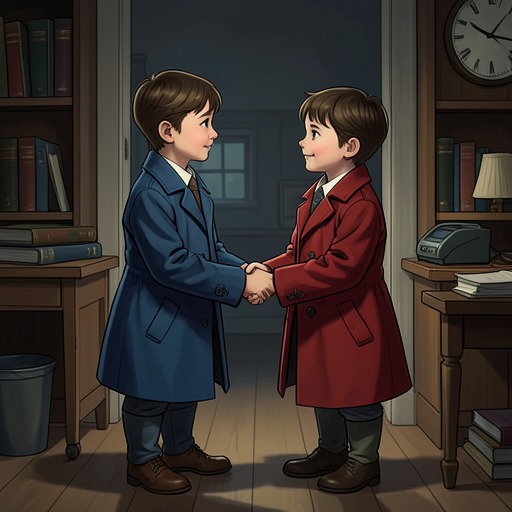
Hans Brinker—Gretel Brinker
Hans Brinker, or The Silver SkatesHans Brinker and Gretel Brinker’s relationship turns material hardship into an occasion for mutual care: each sibling is quicker to recommend the other than to claim an advantage for themself. Their strongest early test comes when Hilda van Gleck can offer money for only one pair of skates. Hans gives up his own chance to race so Gretel can have skates that fit, making his affection practical, costly, and directed toward her future.
Shared Circumstances and Mutual Regard
The siblings are introduced together on a bright December morning, kneeling beside a frozen canal in Holland. They are thinly clad while better-equipped skaters pass them, a contrast that places their relationship within the Brinker family’s poverty from the outset. Their circumstances are shared, but the scene’s emphasis is not on rivalry over scarce resources: the two children face the cold and their limited means as a pair.
That mutual regard becomes explicit when Hilda van Gleck asks which of them is the better skater. Hans promptly names Gretel, while Gretel answers at the same moment that Hans is better. Each assessment puts the other first. The difference between their answers also matters: Hans can see Gretel’s ability, while Gretel can imagine Hans’s prospects. Neither treats the possible prize as a reason to diminish the other.
The Skates and Hans’s Choice
Hilda has only eight kwartjes left from her monthly allowance, enough for at most one pair of skates. She gives the money to Hans and asks the siblings to decide who has the stronger chance in the race. The gift is therefore help with a choice attached: it cannot equip both children, and they must determine whose opportunity to support.
Hans has long wanted good steel runners and believes he could outdistance most of the boys on the canal. He has heard of the race and has ached for the chance to test himself against the other children. His decision is not made because he lacks ambition; the narrative makes clear how intensely he wants to skate. But he also recognizes Gretel’s potential. He thinks her strong, lithe frame might, after a week’s practice on good runners, make her a better skater than Rychie Korbes or even Katrinka Flack.
That estimate changes the meaning of the money in his hand. Hans resolves that if Gretel will not take the jacket, she should take the skates, and he tells her he can wait and save for a fine pair of his own someday. Gretel protests that Hilda gave the money to him, then suggests a compromise: they might share a pair that is too small for Hans and too large for her. Hans refuses this practical-sounding arrangement because a poor fit would make skating difficult for Gretel. He recalls that she stumbled in their wooden skates before he curved their ends, and insists that the new pair must fit her exactly.
The choice is thus more than a simple surrender of a prize chance. Hans considers what Gretel needs to make her ability count: suitable equipment and time to practise before the race. He urges her to practise whenever she can so she may win the Silver Skates. In his view, her success is not a lesser substitute for his own; it is the outcome worth preparing for.
Care Under Pressure
The siblings’ separate actions during their father’s illness extend the same pattern of shared responsibility. Raff Brinker lies moaning on his rough bed, while Dame Brinker bathes his forehead and prays that he will not die. Hans has set out in desperation for Leyden to find Dr. Boekman and persuade him to come at once. Gretel remains at home, where she does the work she can: she wipes the brick floor, brings peat for the fire, melts ice for her mother, and tries to make a bed comfortable enough for her to rest.
Gretel also attends to her mother’s exhaustion and clothing, urging her to lie down and offering to fold away her pretty dress. The scene gives the siblings different duties rather than placing them in competition: Hans goes to seek the doctor, and Gretel sustains the household beside the sickbed. Both actions arise within the same emergency and are directed toward the family’s immediate needs.
A Relationship Made Through Action
The bond between Hans and Gretel is conveyed through decisions and work more than through declarations. Hans understands that a pair of skates that merely exists between them is not enough; they must fit Gretel if she is to practise and race. Gretel, for her part, does not simply accept his sacrifice without hesitation: she points out that Hilda gave him the money and tries to find a way for both to use the skates. Their exchange makes the gift emotionally reciprocal even though Hans ultimately bears the greater material cost.
Across these episodes, scarcity does not disappear, and the siblings cannot always share the same task or opportunity. Instead, they respond by noticing one another’s needs. Hans turns money intended for his own chance into equipment for Gretel; later, their efforts divide between the journey for medical help and care at home. The relationship’s significance lies in that repeated readiness to make an individual capacity serve the family, and especially to give a sibling room to act and succeed.